Descargar Musica Folklorica Instrumental Chilena
And rock genre musicians may memorize the melodies for a new song, which means that they only need to provide a to guide improvising musicians. Musical composition, music composition, or simply composition, can refer to an piece or work of, either or, the of a musical piece, or to the process of creating or writing a new piece of music. People who create new compositions are called. Composers of primarily songs are usually called; with songs, the person who writes for a song is the. In many cultures, including Western, the act of composing typically includes the creation of, such as a which is then performed by the composer or by other instrumental musicians or singers. In popular music and traditional music, songwriting may involve the creation of a basic outline of the song, called the, which sets out the, and chord progression.
In classical music, (choosing the instruments of a large such as an which will play the different parts of music, such as the melody, and so on) is typically done by the composer, but in and in, songwriters may hire an to do the orchestration. In some cases, a pop or traditional songwriter may not use written notation at all, and instead compose the song in their mind and then play, sing or record it from memory. In jazz and popular music, notable by influential performers are given the weight that written or printed scores play in classical music.Although a musical composition often uses musical notation and has a single author, this is not always the case. A work of music can have multiple composers, which often occurs in popular music when all members of a band collaborate to write a song, or in musical theatre, when one person writes the melodies, a second person writes the lyrics, and a third person orchestrates the songs.
Cambodian Harp
A piece of music can also be composed with words, images, or, since the 20th century, with computer programs that explain or notate how the singer or musician should create musical sounds. Examples range from avant-garde music that uses, to text compositions such as 's, to computer programs that select sounds for musical pieces. Music that makes heavy use of randomness and chance is called, and is associated with contemporary composers active in the 20th century, such as,. A more commonly known example of chance-based music is the sound of jingling in a breeze. The study of composition has traditionally been dominated by examination of methods and practice of Western classical music, but the definition of composition is broad enough to include the creation of popular music and traditional music songs and instrumental pieces, and to include spontaneously improvised works like those of performers and African percussionists such as.Although in the 2000s, composition is considered to consist of the manipulation of each (, melody, form, and ), according to, 2:12):Composition consists in two things only.

The first is the ordering and disposing of several sounds.in such a manner that their succession pleases the ear. This is what the Ancients called melody. The second is the rendering audible of two or more simultaneous sounds in such a manner that their combination is pleasant.
This is what we call harmony, and it alone merits the name of composition. Main article:These techniques draw parallels from visual art's. Sometimes, the entire form of a piece is, meaning that each part is different, with no repetition of sections; other forms include, and others. Some pieces are composed around a set, where the compositional technique might be considered the usage of a particular scale. Others are composed during performance (see ), where a variety of techniques are also sometimes used. Some are used from particular songs which are familiar. The scale for the used, including the and note, is important in musical composition.
Similarly, music of the employs compositions that are rigidly based on a specific mode often within, as does in both the and the system. Indian tradition In the music tradition of India there are many forms of musical composition.
To some degree this is on account of there being many musical styles prevalent in different regions of the country, such as, and so forth. Another important influence in composition is its link with, both indigenous and also from musical culture of, and Bengal.In the Hindustani musical tradition, (originally in and later adaptations in and ) is among one of the ancient compositions and had formed the base for other forms in this music tradition such as,. In the Karnatak music tradition the compositions are in the form of,. Main articles: andThe task of adapting a composition for different is called or, may be undertaken by the composer or separately by an arranger based on the composer's core composition. Based on such factors, composers, orchestrators and arrangers must decide upon the instrumentation of the original work. In the 2010s, the composer can virtually write for almost any combination of instruments, ranging from a, wind and brass sections used in standard to electronic instruments such as. Some common group settings include music for full (consisting of strings, woodwinds, brass and percussion), (which consists of larger sections and greater diversity of woodwind, brass, and percussion instruments than are usually found in the orchestra), or a chamber group (a small number of instruments, but at least two).
The composer may also choose to write for only one instrument, in which case this is called a. Solos may be unaccompanied, as with works for solo piano or solo cello, or solos may be accompanied by another instrument or by an ensemble.Composers are not limited to writing only for instruments, they may also decide to write for (including works, some symphonies (e.g., and ). Composers can also write for. Alternatively, as is the case with, the composer can work with many sounds often not associated with the creation of music, such as, and so forth. In ' Listening Out Loud, she explains how a composer must know the full capabilities of each instrument and how they must complement each other, not compete.
Descargar Musica Folklorica Instrumental Chilena De
She gives an example of how in an earlier composition of hers, she had the tuba playing with the piccolo. This would clearly drown the piccolo out. Each instrument chosen to be in a piece must have a reason for being there that adds to what the composer is trying to convey within the work.
Arranging. Main article:Arranging is composition which employs prior material so as to comment upon it such as in and various contemporary classical works. Interpretation Even when music is notated relatively precisely, as in Western classical music from the 1750s onwards, there are many decisions that a performer or conductor has to make, because notation does not specify all of the elements of musical performance. The process of deciding how to perform music that has been previously composed and notated is termed 'interpretation.' Different performers' or conductor's interpretations of the same work of music can vary widely, in terms of the tempos that are chosen and the playing or singing style or of the melodies.
Composers and songwriters who present their own music in a concert are interpreting their songs, just as much as those who perform the music of others. The standard body of choices and techniques present at a given time and a given place is referred to as, whereas interpretation is generally used to mean the individual choices of a performer. Copyright and legal status. The examples and perspective in this section may not represent a of the subject. You may, discuss the issue on the, or, as appropriate. ( December 2010) is a government-granted which, for a limited time, gives a composition's owner—such as a composer or a composer's employer, in the case of —a set of exclusive rights to the composition, such as the exclusive right to publish describing the composition and how it should be performed.
Copyright requires anyone else wanting to use the composition in the same ways to obtain a license (permission) from the owner. In some jurisdictions, the composer can, in part, to another party. Often, composers who aren't publishing companies themselves will temporarily assign their copyright interests to formal publishing companies, granting those companies a license to control both the publication and the further licensing of the composer's work. Law, not copyright law, governs these composer–publisher contracts, which ordinarily involve an agreement on how profits from the publisher's activities related to the work will be shared with the composer in the form of.The scope of copyright in general is defined by various international treaties and their implementations, which take the form of national, and in jurisdictions,. These agreements and corresponding body of law distinguish between the rights applicable to sound recordings and the rights applicable to compositions. For example, 's is in the, but in most of the world, recordings of particular performances of that composition usually are not. For copyright purposes, and other performed words are considered part of the composition, even though they may have different authors and copyright owners than the non-lyrical elements.
Musica Folklorica De Guatemala
Many jurisdictions allow for of certain uses of compositions. For example, copyright law may allow a record company to pay a modest fee to a to which the composer or publisher belongs, in exchange for the right to make and distribute CDs containing a 's performance of the composer or publisher's compositions.
The license is 'compulsory' because the copyright owner cannot refuse or set terms for the license. Copyright collectives also typically manage the licensing of public performances of compositions, whether by live musicians or by transmitting sound recordings over radio or the Internet.In the U.S. Even though the first US copyright laws did not include musical compositions, they were added as part of the. According to a circular issued by the on Copyright Registration of Musical Compositions and Sound Recordings, a musical composition is defined as 'A musical composition consists of music, including any accompanying words, and is normally registered as a work of the performing arts. The author of a musical composition is generally the composer, and the lyricists if any. A musical composition may be in the form of a notated copy (for example sheet music) or in the form of a phonorecord (for example cassette tape, LP, or CD).
Sending a musical composition in the form of a phonorecord does not necessarily mean that there is a claim to copyright in the sound recording.' In the UK defines a musical work to mean 'a work consisting of music, exclusive of any words or action intended to be sung, spoken or performed with the music.' In India In India The Copy Right Act, 1957 prevailed for original literary, dramatic, musical and artistic work until the Copyright (Amendment) Act, 1984 was introduced. Under the amended act, a new definition has been provided for musical work which states 'musical works means a work consisting of music and included any graphi notation of such work but does not included any words or any action intended to be sung, spoken or performed with the music.' See also.
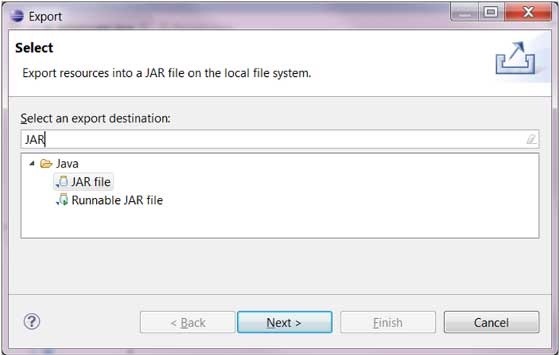 If you clear this checkbox, then you will be prompted to confirm thereplacement of each file that will be overwritten. (This option is unimportant for CS307.). Select or clear the Overwrite existing files without warningcheckbox. In the Select the export destination field, either typeor click Browse to select a location for the JAR file. Select or clear the Compress the contents of the JAR filecheckbox.